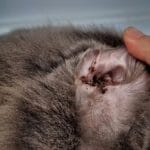
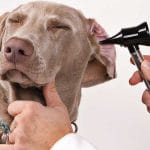
IN THIS POST
- What the Color of the Scab Tells You
- What the Location of the Scab Tells You
- How Scabs Form: The Normal Healing Process
- General Signs to Watch Out For
- When Scabs Don’t Form
- Systemic Illnesses Affecting the Skin
- Pyoderma: Levels of Skin Infection
- Treatment and Prevention
- When to See Your Veterinarian
- References
Finding a crusty spot while you are petting your dog is always a bit of a worry. Most of the time, it is just a simple scab formed by platelets in the blood to protect a nick or scratch while it heals. But when these spots appear out of nowhere or keep coming back, it is usually a sign that something else is going on under the fur.
This guide helps you figure out what those scabs mean based on where they are, what color they are, and how to get your dog’s skin healthy again.
What the Color of the Scab Tells You
Dark Red or Brown: Indicates normal clotting of blood. These are typical for minor nicks and scratches.
Fresh Red or Bloody: Suggests the wound is being repeatedly reopened by the dog (the “itch-scratch cycle”). Breaking this cycle is essential: address the underlying itch, and consider an Elizabethan collar if the dog will not leave the area alone.
Black Scabs: Common when blood or infected drainage has fully oxidized. These often cover deeper wounds or areas affected by trauma (dog fights, object impact). Long-standing infections that produce drainage will also result in dark, crusty scabs. The darker the scab, the longer the drying process has been occurring.
Yellow or Honey-Colored: A hallmark of bacterial infection. These golden crusts usually come from Staphylococcus pseudintermedius bacteria that naturally live on the skin but have overgrown in a wound. When it overgrows in broken skin, it produces pus that dries into yellow or honey-colored crusts. Where you see yellow scabs matters:
- Ears: Yellow crusting inside or around the ear often signals a bacterial ear infection (otitis externa). Bacterial ear discharge tends to be lighter brown or yellow, compared to the darker brown discharge typical of yeast infections. Dogs with floppy ears and dogs who swim frequently are most prone.
- Paws: Yellow scabs between the toes or on the paw pads point to interdigital pyoderma. Bacteria thrive in the warm, moist spaces between toes. Dogs that lick their paws obsessively worsen the condition.
- Nose: Yellow crusting on the nose or around the lips may indicate mucocutaneous pyoderma, a type of bacterial skin infection that targets the junctions where skin meets mucous membranes. German Shepherds, Bichon Frises, and Poodles may be predisposed.
- Belly: In puppies, yellow crusts on the belly are often impetigo (see Belly and Groin section below).
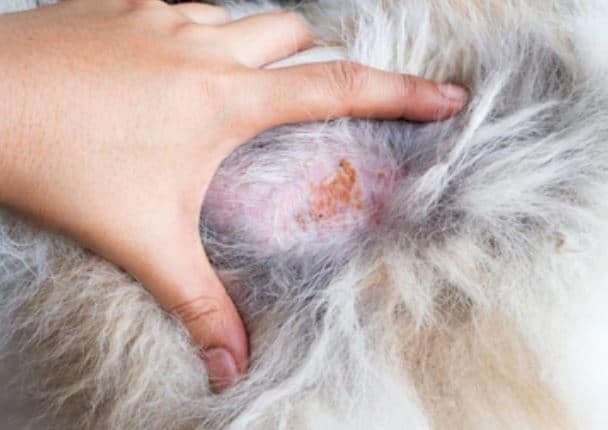
Yeast-Related Scabs: Yeast infections (Malassezia) can also cause crusting and scabbing, though the appearance differs from bacterial scabs.
Black “Specks”: Often flea dirt rather than a true skin scab. Use the Paper Towel Test described below to confirm.
Crusty, Flaky, or Layered Scabs: When scabs build up in thick, layered crusts, the underlying skin has not had a chance to heal. This happens when infections persist without treatment, or when the dog keeps reopening the wound. Prolonged crusting needs veterinary evaluation.
What the Location of the Scab Tells You
Identifying where the scabs are located is the fastest way to narrow down the cause.
Ears and Head
Sarcoptic Mange (Scabies) This is caused by microscopic mites that burrow deep into the skin to lay eggs. It is highly contagious between dogs and can be spread to humans (zoonotic). Since some types of mange infect humans, wash all bedding and clothing that comes into contact with your dog during treatment. Disinfect hard surfaces and vacuum regularly to prevent spread.
- Location: It usually starts on the margin of the ear, face, and elbows before spreading.
- Signs: Thick crusting and relentless scratching.
- Diagnosis: A skin scraping can confirm the diagnosis, though false negatives are common because the mites burrow deep.
- Treatment: Oral or topical parasiticides. Isoxazolines* (Bravecto, NexGard, Simparica) are now preferred as first-line treatment. Ivermectin is still used but requires MDR1 testing in herding breeds (Collies, Australian Shepherds, Shelties) due to toxicity risk.
*The FDA has noted rare neurologic side effects (tremors, loss of coordination, seizures) with isoxazoline products. Dogs with a history of seizures should be evaluated before use.
Demodectic Mange This is also caused by microscopic mites. But unlike other mites, these are not contagious.
- Location: Usually localized patches on the face and head, especially in puppies or dogs with a weak immune system.
- Signs: Patchy hair loss and scabbing.
- Diagnosis: Typically confirmed by a skin scraping where the vet looks for the mites under a microscope.
- Treatment: Many small patches resolve on their own, but monitoring is important. If it spreads, your vet will likely prescribe isoxazoline* medications like Bravecto, NexGard, or Simparica.
*The FDA has noted rare neurologic side effects (tremors, loss of coordination, seizures) with isoxazoline products. Dogs with a history of seizures should be evaluated before use.
Ringworm (Dermatophytosis) This is a fungal infection, not a worm. It is highly contagious and zoonotic, meaning it spreads easily to humans and other pets. Hence, it is very important to wash bedding, clothing, and your hands after every treatment session to prevent spread.
- Location: Can appear anywhere, but often starts on the head, ears, or paws.
- Signs: Circular, crusty lesions that are often pink or red with a raised border and scaly center.
- Diagnosis: May include a Wood’s lamp (some strains fluoresce green), fungal culture, or PCR testing. Fungal infections tend to start as a small irritation that spreads outward in size over the skin. If a scabby patch is growing in a circular pattern, suspect ringworm.
- Treatment: Topical antifungals for mild cases and oral antifungals like ketoconazole or itraconazole for widespread infections.
Fly Strike (Fly Bite Dermatitis) This is caused by biting flies. It is not contagious between dogs, but flies will often target multiple pets in the same area.
- Location: Most common on the tips of dogs with erect or upright ears.
- Signs: Flies bite the ear tips, leaving bloody sores that dry into thick, black crusts. The cycle repeats as flies return to the damaged tissue.
- Diagnosis: Diagnosis is straightforward: if you see black, crusty sores on the ear tips and flies nearby, it is almost certainly fly strike.
- Treatment: Clean the ears thoroughly, apply a topical antibiotic ointment, and use fly repellent products. In severe cases, you may need a prescription level topical ointment.
Ear Mites These are microscopic parasites. They are highly contagious between dogs and cats, though they rarely affect humans.
- Location: Inside and around the ear canal.
- Signs: A dark, crumbly discharge that looks like coffee grounds, often paired with scabbing from intense scratching.
- Diagnosis: A veterinarian can confirm the presence of mites using an otoscope, which is a lighted tool used to look deep into the ear canal, or by looking at a sample of the discharge under a microscope.
- Treatment: Veterinary prescribed topicals are the safest and most effective way to eliminate mites.
Back, Spine, and Tail
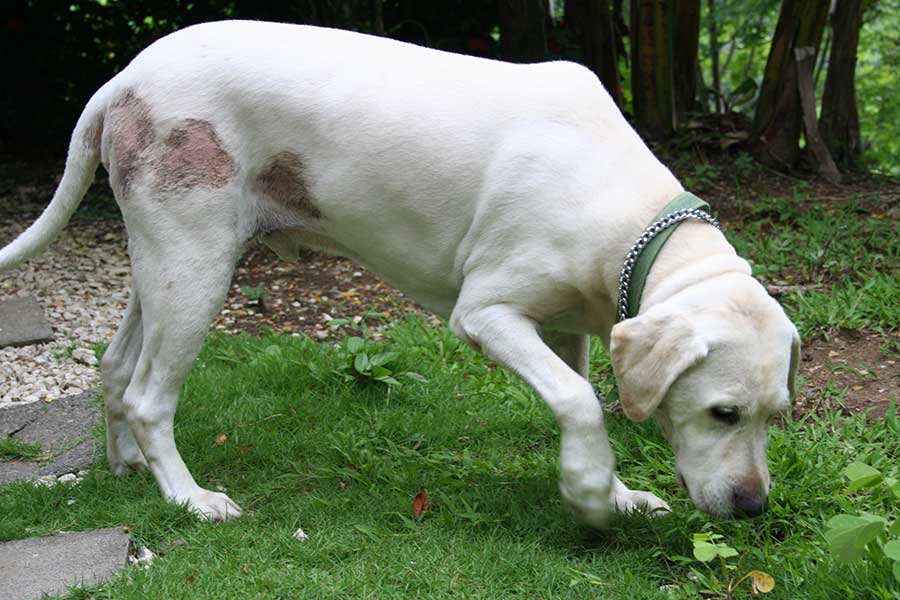
Flea Allergy Dermatitis (FAD) This is caused by an allergic reaction to proteins in flea saliva. Even a single bite can trigger an intense reaction in sensitive dogs. Wash all bedding in hot water and vacuum carpets and upholstery thoroughly.
- Location: Most common cause of scabs on the lower back and base of the tail.
- The Paper Towel Test: Run a flea comb through the hair and place the debris on a wet paper towel. If black specks turn red or brown, it is “flea dirt” (digested blood), confirming flea activity.
- Treatment: Relies primarily on prescription flea preventatives (oral or topical). Medicated flea shampoos can provide additional relief and work best alongside these preventatives, not as a standalone treatment. Topical steroids may also be prescribed for the allergic skin reaction.
Comedo Syndrome (Schnauzer Back) A genetic condition most common in Miniature Schnauzers. It is not life-threatening but persists throughout the dog’s life with varying severity.
- Location: Along the spine.
- Look for: Black, crusty bumps with hair loss, skin thickening, reddening, and an oily, foul-smelling coat. The smell is often the first thing owners notice.
- Treatment: Regular bathing with a benzoyl peroxide medicated shampoo helps manage symptoms.
Folliculitis Inflammation of the hair follicles, often secondary to mange, seborrhea, or allergies.
- Location: Common on the back, groin, neck, and abdomen.
- Look for: Small, pimple-like bumps that rupture into crusty pustules.
- Treatment: Mild cases respond to medicated shampoos with chlorhexidine or benzoyl peroxide. Deeper infections require oral antibiotics for up to eight weeks.
Trauma Scratches from cats, rough terrain, or fights.
- Location: Often along the spine and on the side of the body.
- The Dime-Size Rule: If the wound is larger than a dime, it may be too large for a scab to heal on its own. Seek veterinary care to have it closed with sutures. When in doubt about wound size or depth, consult your vet.
- Home care for smaller wounds: Keep the area clean and dry. A warm compress applied twice daily for 10 to 15 minutes can help reduce swelling. If redness worsens or you notice signs of infection, stop and consult your veterinarian.
- Prevent reopening: An Elizabethan (cone) collar or a T-shirt covering the wound will stop your dog from licking or chewing at the scab.
Belly and Groin
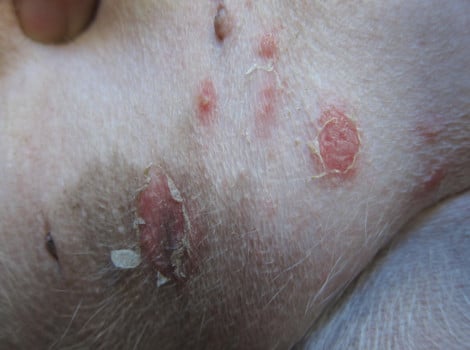
Impetigo A bacterial skin infection most common in puppies.
- Location: Hairless parts of the belly and groin.
- Look for: Small, pus-filled blisters that rupture to form honey-colored crusts.
- Treatment: Most cases are mild and resolve with topical antibacterial treatment. Persistent or widespread impetigo may need oral antibiotics.
Bacterial Pyoderma A general term for bacterial infections of the skin. If left untreated, it can progress into an abscess (a pus-filled wound under the skin) or a hot spot (an open, oozing wound).
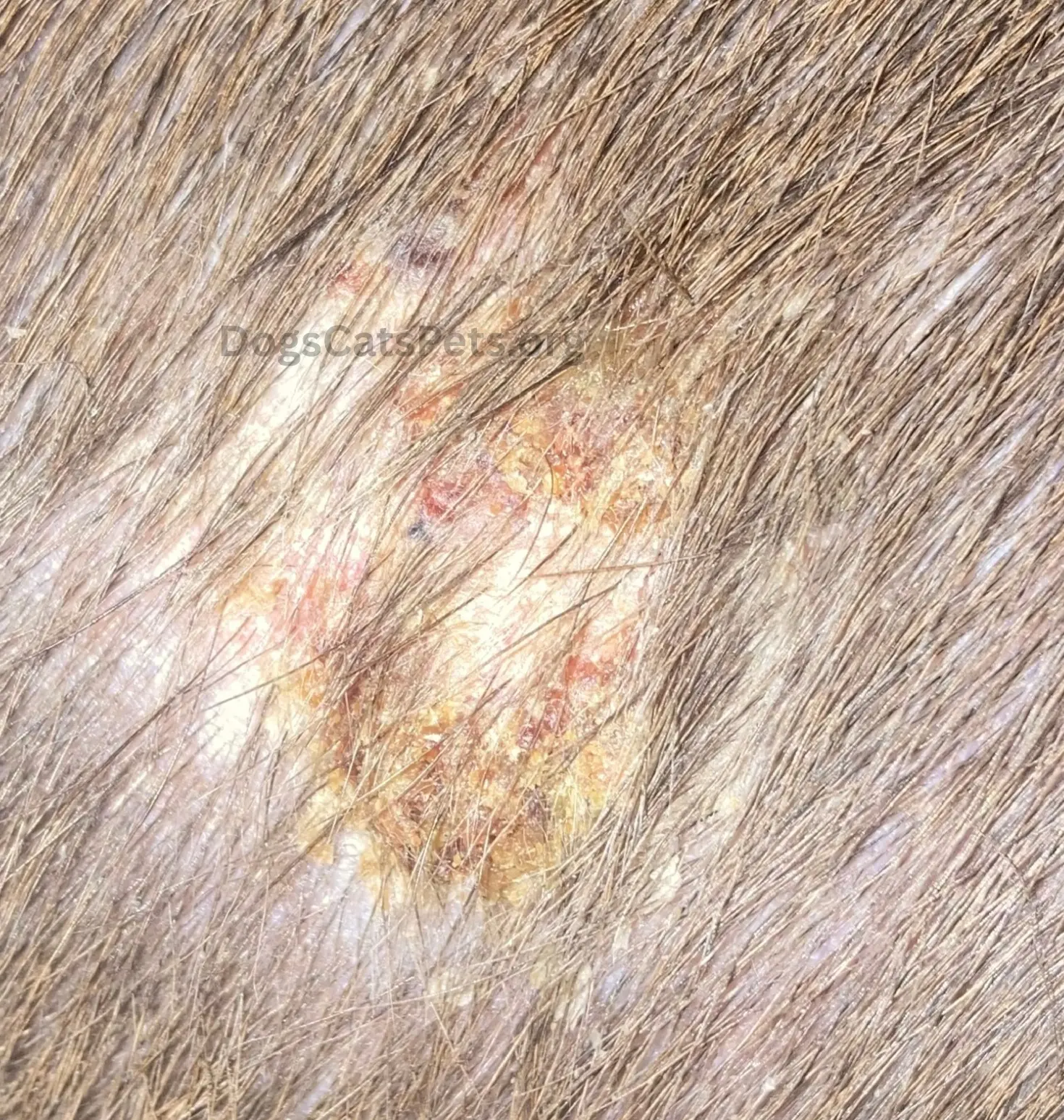
- Location: Can occur anywhere, but skin folds, belly, and groin are common.
- Look for: Lesions, pustules, dried discharge, and partial hair loss.
- Risk factors: Dogs with endocrine diseases (hypothyroidism, Cushing’s disease), food allergies, flea allergies, or parasitic infestations are at higher risk.
- Treatment: Antibiotics to clear the infection and topical medication for the lesions. Your vet will first clip the hair in the area to allow oxygen and topical medications to reach the skin. If it is difficult to make your dog take pills, ask your vet about a long-acting antibiotic injection that provides 14 days of continuous treatment.
Yeast Infections Caused by Malassezia yeast, which thrives in moist skin folds. Almost always secondary to allergies or immune suppression.
- Location: Skin folds, belly, groin, ears, and paws.
- Look for: A distinct “corn chip” or musty smell, greasy skin, redness. Keep in mind that any irritated or oozing skin infection can smell bad, even without yeast. A foul odor alone does not confirm a yeast infection.
- Treatment: Medicated shampoos are the first line, with thorough drying afterward. Oral ketoconazole for persistent cases. Avoid covering yeast-affected areas with clothing: they need to stay dry and aired out.
Any Location
Skin Allergies Environmental allergens (dust mites, pollen, mold), food allergies, and contact allergies can all cause itching and inflammation anywhere on the body. Chronic scratching breaks the skin, leading to scabs.
- Breeds predisposed: Boxers, English Setters, Labrador Retrievers, West Highland White Terriers, Bulldogs, and Dalmatians.
- Treatment: Identifying and eliminating the allergen is the primary goal. Apoquel, Cytopoint, or corticosteroids control itching while the trigger is being identified.
Parasites (General) Fleas, mites, lice, and ticks all cause skin irritation and scabbing. Bites cause bleeding, and the dog’s scratching makes it worse.
- Treatment: Year-round parasite control prevents most of these issues.
- Pro-Tip: Some parasites, like ticks or clusters of lice, can resemble oddly shaped scabs attached to the hair shaft. Never pull at a suspicious scab without checking for legs or a head first.
- Spotting fleas: Fleas are easier to spot on thinner-haired parts of the body such as the belly. If you see scabs concentrated there, check for live fleas before assuming a skin condition.
Scabbing with Hair Loss
Hair loss alongside scabbing is a sign that something more than a surface wound is going on. Your dog may scratch or lick until the hair falls out. Parasites, fungal infections, and metabolic illnesses like hypothyroidism can also cause hair loss with scabbing.
- Diagnosis: Your vet may take a skin scraping: a non-invasive procedure where a layer of cells is gently scraped from the skin and examined under a microscope or placed in a growth medium.
- Itch relief: Antihistamines such as Zyrtec or Benadryl may provide mild relief in roughly 20% of allergic dogs. Veterinary therapies like Apoquel or Cytopoint are often more reliable.
- Prevent further damage: An Elizabethan collar can stop the scratch-scab cycle while treatment takes effect.
How Scabs Form: The Normal Healing Process
Think of a healthy scab as a “natural stitch” that pulls the edges of the skin back together. It creates a protective seal while the body repairs the tissue underneath.
Most normal scabs start with a bit of clear or yellow-tinted oozing before hardening into a crust. Then they should shrink around the edge until they flake off. If you see this, the skin is doing its job. However, when scabs appear without an injury or refuse to fall off after a week or two, it is worth looking into.
General Signs to Watch Out For
It is normal for a scab to itch as cells move to the wound to repair the tissue. You might also notice slight redness or inflammation around the scab.
If a scab is removed before the healing is complete, the skin underneath may look red or shiny. While scars are normal and fade over time, it can take months or even years for the tissue from a deep wound to match the surrounding skin. Smaller nicks often leave no scar at all.
However, there are signs that a scab is not healing normally. You should visit your vet if you notice:
- The “Infinite Scab”: Scabs that don’t seem to heal or constantly reform in the same spot.
- Failed Healing: Repeated loss of scabs without the tissue underneath actually closing up.
- Clustering: Many scabs forming in one area, especially if you see hair loss or extreme itching.
- Systemic Signs: Scabbing paired with lethargy, a foul odor, or a loss of appetite.
When Scabs Don’t Form
Sometimes a lack of scabbing is the concern. Open wounds or sores that do not clot or heal may indicate a clotting disorder, toxicity, or underlying illness. Genetic blood disorders common in breeds like Doberman Pinschers, or ingestion of rat poison, can cause prolonged bleeding and are considered a medical emergency. Wounds that will not stop bleeding or do not form a scab should be examined by your vet immediately.
Emergency Care: If a wound does not stop bleeding due to rat poison or a clotting disorder, your dog may require blood transfusions and intensive supportive care. This is always an emergency.
Systemic Illnesses Affecting the Skin
Sometimes, skin scabs are a “mirror” of what is happening inside your dog’s body. If the internal balance is off, the skin is often the first place to show it.
Hypothyroidism: When the thyroid doesn’t produce enough hormones, your dog’s entire metabolism slows down. This leads to dry, flaky skin, a thinning coat, and a “lazy” immune system that cannot fight off secondary infections. If your dog has chronic scabbing along with weight gain and lethargy, a simple blood test can confirm it. Most dogs bounce back quickly with a daily hormone supplement.
Cushing’s Disease (Hyperadrenocorticism): This happens when the body produces too much cortisol, which effectively thins the skin and makes it easy for infections to take hold. Dogs with Cushing’s often have hair loss and scabs that just won’t heal. A major “red flag” for advanced Cushing’s is calcinosis cutis. These are thickened, stony patches of skin that feel gritty or even “crunchy” when you pet your dog. If you notice these hardened deposits, your vet will likely recommend blood work and specialized hormone testing to confirm the diagnosis.
Addison’s Disease (Hypoadrenocorticism): This disease is the “opposite” of Cushing’s. When the body doesn’t have enough cortisol, the skin loses its ability to repair itself, leading to poor wound healing and persistent scabbing. Because Addison’s can also cause vomiting, weakness, and even total collapse, it requires urgent veterinary care to stabilize your dog.
Diabetes Mellitus: High blood sugar makes it very hard for the body to heal. Diabetic dogs are much more prone to recurring skin infections. Even a tiny nick or a minor scratch can turn into a slow-healing, crusty scab because the body’s natural defense system is overwhelmed.
Pyoderma: Levels of Skin Infection
When scabs are caused by a bacterial infection, the depth of that infection determines how long treatment will take.
Surface Pyoderma
Affected Area: Outermost dead skin layers (e.g., Hot Spots)
Typical Scabs: Moist, red, or “crusty” surface patches
Healing Time: 3 to 7 days with topical care
Superficial Pyoderma
Affected Area: Hair follicles and upper skin layers
Typical Scabs: Classic “honey-colored” or yellow crusts
Healing Time: 3 to 4 weeks of treatment
Deep Pyoderma
Affected Area: Deep dermis (often chin, muzzle, or paws)
Typical Scabs: Bloody, thick, or foul-smelling crusts
Healing Time: 8 to 12 weeks of oral antibiotics
Treatment and Prevention
Identify the Trigger: Treat the underlying cause (parasites, fungus, or bacteria) first. Use the location and appearance of the scabs, along with other symptoms (itching, hair loss, odor, discharge), to narrow down possibilities. Treatment duration varies depending on severity and response, and should always be guided by a veterinarian. Antibiotics should only be used when prescribed, as overuse contributes to resistance.
Parasite Control: Use year-round flea and tick preventatives. For puppies under 8 weeks, plain dish soap baths can suffocate live fleas safely. Follow the bath with a flea comb to remove the dead fleas, as puppies this young are too small for most medications.
Supportive Care: Use an Elizabethan (cone) collar or a T-shirt covering the wound to prevent your dog from licking, chewing, or removing scabs prematurely.
Topical Relief: Medicated shampoos (chlorhexidine or benzoyl peroxide) can help with bacterial and fungal causes. Aloe vera gel soothes localized irritation, and coconut oil moisturizes dry, flaky areas around healing scabs. Use only pet-safe formulations of both: some aloe products contain additives that are toxic if ingested, and coconut oil can worsen yeast-related conditions if applied to the wrong type of infection.
Prevent Recurrence: Maintain flea and tick prevention year-round. Feed a balanced diet that supports skin health. Keep the coat clean and groomed. Address underlying conditions like allergies or endocrine diseases with ongoing veterinary care.
When to See Your Veterinarian
Consult a professional if you notice:
- Scabs that are spreading rapidly or will not heal after two weeks of home care
- A foul odor or green/yellow discharge from the scabbed area
- Hair loss in patches alongside the scabbing
- Systemic signs like lethargy, loss of appetite, weight changes, or excessive thirst
- Wounds larger than a dime that may require sutures rather than a natural scab
- Suspected mange, ringworm, or any contagious condition
Note from the Editors: This guide was originally authored by Dr. Winnie, DVM. It was updated to reflect current veterinary safety standards. To ensure the highest clinical standards, this post is currently in our queue for a veterinary re-review.
References
- Merck Veterinary Manual: Pyoderma in Dogs
- Merck Veterinary Manual: Disorders of the Outer Ear in Dogs
- Merck Veterinary Manual: Cushing Disease (Pituitary-Dependent Hyperadrenocorticism) in Animals
- Merck Veterinary Manual: Mange in Dogs and Cats
- PetMD: Pyoderma in Dogs
- PetMD: Dog Ear Infections
- VCA Animal Hospitals: Pyoderma in Dogs
- VCA Animal Hospitals: Ear Infections in Dogs (Otitis Externa)
- VCA Animal Hospitals: Care of Open Wounds in Dogs
- International Society for Companion Animal Infectious Diseases (ISCAID): Antimicrobial Use Guidelines for Canine Pyoderma